Что такое findslide.org?

FindSlide.org - это сайт презентаций, докладов, шаблонов в формате PowerPoint.


Для правообладателей

Обратная связь

Email: Нажмите что бы посмотреть 
Яндекс.Метрика

Презентация на тему Kazakhstan-russian medical university

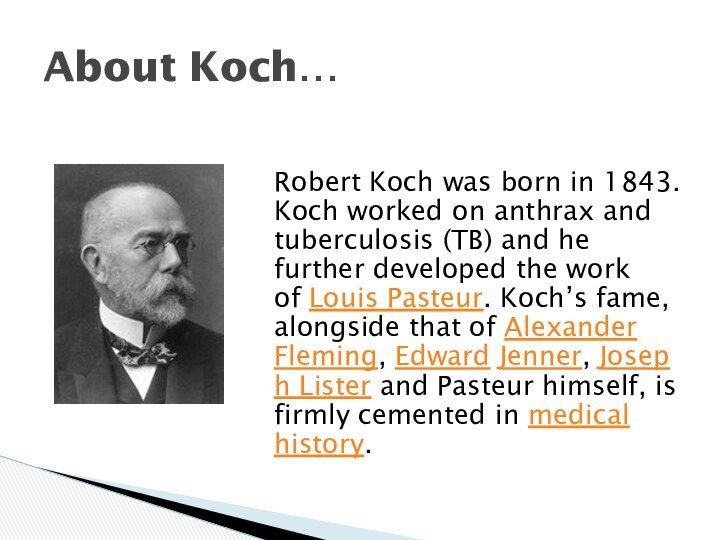
Robert Koch was born in 1843. Koch worked on anthrax and tuberculosis (TB) and he further developed the work of Louis Pasteur. Koch’s fame, alongside that of Alexander Fleming, Edward Jenner, Joseph Lister and Pasteur himself, is firmly cemented in medical history.About Koch…
KAZAKHSTAN-RUSSIAN MEDICAL UNIVERSITYINDEPENDENT WORKTheme:Robert KochEsbalanova A.T.Kosbatyrova N.B.203 “b” general medicineAlmaty,2012 Robert Koch was born in 1843. Koch worked on anthrax and tuberculosis Koch came from a poor mining family and it took him a Koch was a doctor and he had a detailed knowledge of the The first disease that Koch investigated was anthrax. This was a disease After this, Koch moved onto germs that specifically affected humans. In 1878, Koch also devised a method of proving which germ caused an infection. The TB germ was much smaller than the anthrax germ so the What was Koch’s legacy? He had finally laid to rest the belief
Слайды презентации

Слайд 2 Robert Koch was born in 1843. Koch worked

Robert Koch was born in 1843. Koch worked on anthrax and

on anthrax and tuberculosis (TB) and he further developed

the work of Louis Pasteur. Koch’s fame, alongside that of Alexander Fleming, Edward Jenner, Joseph Lister and Pasteur himself, is firmly cemented in medical history.

About Koch…


Слайд 3 Koch came from a poor mining family and

Koch came from a poor mining family and it took him

it took him a lot of determination to get

a university place where he first studied mathematics and natural science and then studied medicine.
Pasteur was convinced that microbes caused diseases in humans but his work on cholera had failed. He was never able to directly link one microbe with a disease. Koch succeeded in doing this.

About family…


Слайд 4 Koch was a doctor and he had a

Koch was a doctor and he had a detailed knowledge of

detailed knowledge of the human body – something that

Pasteur, as a research scientist – lacked. He was also skilled in experiments, the result of his work in natural sciences. Qualities that also proved to be important were his ability to work for long periods of time and his patience. However, Koch was also difficult to work with and could not tolerate anyone telling him that his theories were wrong.
In 1872, Koch became district medical officer for a rural area near Berlin. He started to experiment with microbes in a small laboratory he had built for himself in his surgery.

Research works…


Слайд 5 The first disease that Koch investigated was anthrax.

The first disease that Koch investigated was anthrax. This was a

This was a disease that could seriously affect herds

of farm animals and farmers were rightly in fear of it. Other scientists had also been working on anthrax. In 1868, a French scientist called Davaine had proved that a healthy animal that did not have anthrax could get the disease if it was injected with blood containing anthrax. Koch developed this work further and for three years he spent all his spare time finding out what he could about the disease, including its life cycle.
Koch found out that the anthrax microbe produced spores that lived for a long time after an animal had died. He also proved that these spores could then develop into the anthrax germ and could infect other animals.

first disease that Koch investigated


Слайд 6 After this, Koch moved onto germs that specifically

After this, Koch moved onto germs that specifically affected humans. In

affected humans. In 1878, he identified the germ that

caused blood poisoning and septicaemia. He also developed new techniques for conducting experiments that influenced the way many other scientists carried out their experiments. He knew that infected blood contained the septicaemia germ but he could not see these germs under a microscope, and therefore, other scientists were unlikely to believe what he thought to be true without the evidence.
Koch discovered that methyl violet dye showed up the septicaemia germ under a microscope by staining it. He also photographed the germs so that people outside of his laboratory could see them.


Слайд 7 Koch also devised a method of proving which

Koch also devised a method of proving which germ caused an

germ caused an infection. His work was rewarded in

1880 when he was appointed to a post at the Imperial Health Office in Berlin. Here, Koch perfected the technique of growing pure cultures of germs using a mix of potatoes and gelatine. This was a solid enough substance to allow for the germs to be studied better. Koch gathered round him a team of researchers in Berlin in 1881 and began to work on one of the worst diseases of the nineteenth century – tuberculosis (TB).

Слайд 8 The TB germ was much smaller than the

The TB germ was much smaller than the anthrax germ so

anthrax germ so the search for it was difficult.

Using a more specialised version of his dye technique, Koch and his team searched for the TB germ. In May 1882, Koch announced that his team had found the germ. His announcement caused great excitement. It also generated what became known as ‘microbe hunters’ – a new generation of young scientists who were inspired by the work of both Koch and Pasteur. One of those who was inspired by Koch was Paul Ehrlich.

  • Имя файла: kazakhstan-russian-medical-university.pptx
  • Количество просмотров: 135
  • Количество скачиваний: 0